Read the full story as posted on the front page of ARINSA.org

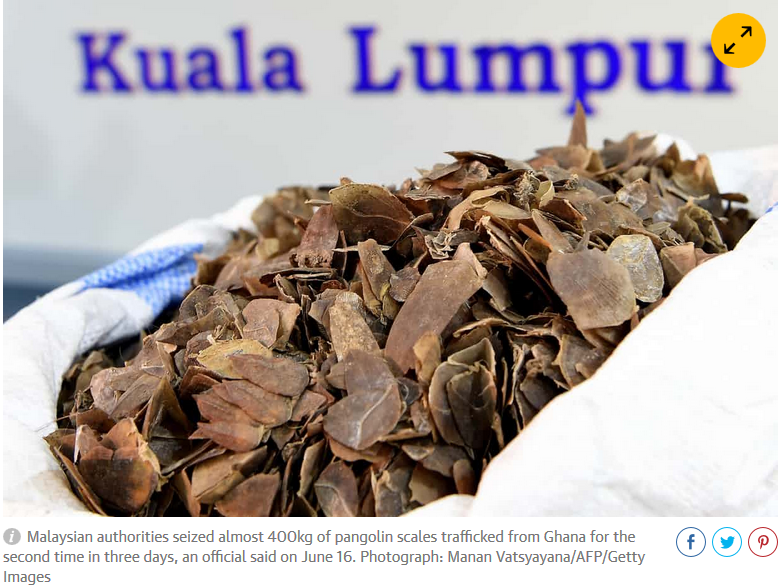
Scale of pangolin slaughter revealed – millions hunted in central Africa alone

by Kudzai Chinoda -

Scale of pangolin slaughter revealed – millions hunted in central Africa alone

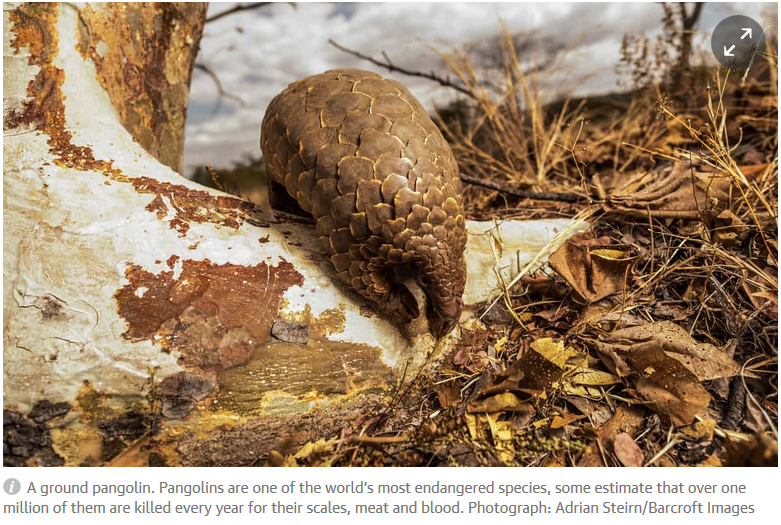
Pangolins are the world’s most trafficked wild mammal and decimated Asian populations have sharply shifted the focus of exploitation to Africa

The true scale of the slaughter of pangolins in Africa has been revealed by new research showing that millions of the scaly mammals are being hunted and killed.

Pangolins were already known to be the world’s most trafficked wild mammal, with at least a million being traded in the last decade to supply the demand for its meat and scales in Asian markets. Populations of Asian pangolins have been decimated, leaving the creatures highly endangered and sharply shifting the focus of exploitation to Africa’s four species.

Pangolins are secretive, nocturnal and some species live in trees, making them very hard to count and the total size of the populations in Africa is unknown. But the new analysis, based on data collected by hundreds of local researchers at scores of hunting sites and bushmeat markets across central and west Africa, found up to 2.7m are being killed every year, with the most conservative estimate being 400,000 a year.

“The number is definitely shocking,” said Daniel Ingram, at the University of Sussex, UK, and who led the research team. “Pangolins have been hunted out of many areas in Asia and recent analyses show there is a growing international trade between Africa and Asia. If we don’t act now to better understand and protect these charismatic animals, we may lose them.”

Pangolins curl up into a scaly ball when threatened, which defeats natural predators like lions but is no defence against human hunters. The researchers found half the animals had been snared or trapped, despite wire snares being illegal in most of the 14 central African nations analysed in the research.

The analysis, published in the journal Conservation Letters, also found that almost half of the pangolins killed were juveniles, an indicator that the populations are being dangerously overexploited as animals are being caught before they can reproduce. This is particularly harmful as pangolins are slow breeding and produce only a single pup every year or two.

The new estimates of pangolins killed are likely to be minimum numbers as they included only three of Africa’s four pangolins, the giant, white-bellied and black-bellied species. The fourth, the cape pangolin, lives in southern and eastern Africa, outside the study area.

Furthermore, it is illegal to kill giant pangolins in all the countries, meaning not all the illicit trade in the animals will be included in the estimates. The giant pangolins are particularly sought after and the researchers found the price demanded in urban markets has soared almost six times since the 1990s. They also found hunting of the African pangolins in 2014 was 150% higher than in the 1970s.

Richard Thomas, from the wildlife trade monitoring network Traffic, said very little had been known about pangolin populations in central and West Africa. He also pointed the “remarkable regularity” of major pangolin seizures. In June alone, Malaysian authorities seized three big shipments of pangolin scales, each representing many thousands of animals and originating from Africa.

A total ban on the international trade in any pangolin species was passed by the Convention on the International Trade in Endangered Species in September. But Ingram said the enforcement of both international and national laws had to be increased to prevent African pangolins following their Asian cousins on the path to extinction.

The demand in Asia for pangolin meat and scales as delicacies and supposed medicinal uses is a major factor in cross-border trade but a significant proportion of African pangolins are eaten locally. Ingram said that measures are also needed to develop alternative livelihoods for African hunters of pangolin, but he believes there is still enough time left to act: “I am optimistic that something can be done.”

Read More: https://www.theguardian.com/environment/2017/jul/20/scale-of-pangolin-slaughter-revealed-millions-hunted-in-central-africa-alone

653 words

The Almighty Dollar - the GuptaLeaks Game Changer

by Kudzai Chinoda -


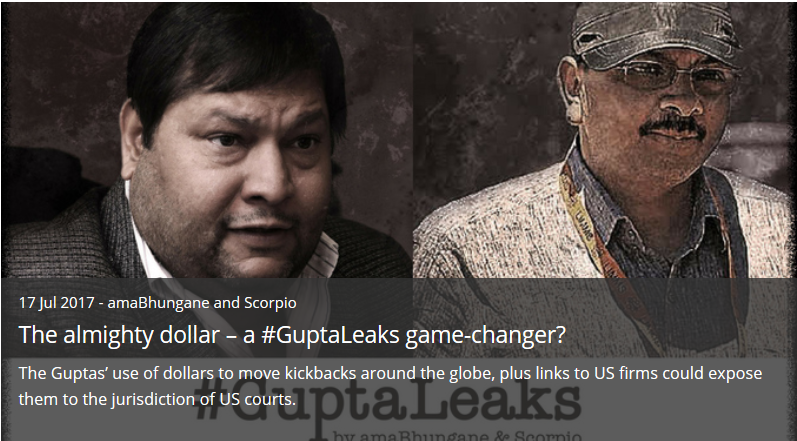
Many kickbacks paid to the Guptas and subsequent money movements were in US dollars. Some washed through US accounts and a US-listed corporation has been implicated. This means the entire alleged conspiracy could be exposed to US investigation and prosecution, according to stringent anti-corruption laws there.


To date, the apparent efforts of the Hawks, South Africa’s priority crime-combating unit, to investigate any of the voluminous allegations made against the Guptas have been minimal to non-existent.

But the Guptas’ repeated use of US dollars to move their kickbacks around the globe, along with previously hidden ties to US companies, may render the Hawks’ efforts (or lack thereof) irrelevant.

Under American anti-bribery and anti-money laundering laws, one link to the United States could expose all members of any broader conspiracy to the jurisdiction of American courts.

In addition to personal US criminal liability, ill-gotten gains are also at risk.

The US Department of Justice’s Kleptocracy Asset Recovery Initiative recently seized billions of dollars of assets – including bank accounts, real estate, art, jewelry, aircraft and yachts – located around the world.

When announcing the latest such seizure last Friday – stemming from contracts corruptly obtained by bribing Nigeria’s former oil minister – a senior official at the US Department of Justice remarked: “Corrupt foreign officials and business executives should make no mistake: if illicit funds are within the reach of the United States, we will seek to forfeit them and to return them to the victims from whom they were stolen.”

US-listed companies

The Guptas’ dealings with software giant SAP potentially provides US authorities with a clear means of getting their foot in the door.

Although headquartered in Germany, SAP’s stock trades on the New York Stock Exchange, thus making the company subject to various US laws, including the Foreign Corrupt Practices Act (FCPA).

Last week, amaBhungane and Scorpio revealed that SAP paid R100-million to Gupta-linked CAD House.

By the end of the week, SAP had replaced its executive team in South Africa and had launched both internal and external investigations, the latter being led by US law firm Baker McKenzie.

To receive maximum credit for cooperating – thereby potentially reducing recommended fines by half – companies are expected to thoroughly investigate and self-report FCPA violations to US authorities.

To be eligible for any such credit, companies are further required to hand over “all relevant facts about individuals involved in corporate misconduct” to the US Department of Justice.

US Dollar and Gmail snares

Forthcoming instalments of the #GuptaLeaks will further detail the Guptas’ frequent transactions in US dollars – the Guptas’ currency of choice of when moving hundreds of millions of dollars to and from its Dubai bank accounts.

For instance, the #GuptaLeaks reveal that much of cash sloshing through the Dubai accounts are the proceeds of so-called “consulting” contracts such as the China South Rail-Transnet contract previously detailed by amaBhungane.

The #GuptaLeaks also reveal that communications related to the CSR kickbacks were carried out using US-based email providers.

Major US law firm, White & Case, explained how such US-dollar transactions and even emails can put someone within the very long reach of US laws, including anti-bribery laws.

“Many US laws — including the Foreign Corrupt Practices Act in certain circumstances and various antifraud statutes — may establish jurisdiction over a crime whenever it involves the use of any ‘means or instrumentality of interstate or foreign commerce’.

“The term is broadly defined by US authorities and may cover any communication or movement that crosses state or international borders, including wire transfers, emails, phone calls, mail and travel.

“Given the reach of US commerce, from free email servers to correspondent banks that clear US dollars for non-US based banks, such a broad definition can significantly increase the reach of US law.”

Beyond transferring many millions of dollars through US-based correspondent banks, the Guptas, their associates and many political figures linked to them frequently used US-based email providers, such as Gmail, Yahoo and Hotmail.

These US-based email accounts were used to communicate on a wide variety of topics including the Sun City wedding expenses, the near-daily US dollar movements to and from Dubai, as well as to make arrangements with parties in the United States who received funds from the Guptas’ accounts in Dubai.

US money laundering Laws

Regarding US anti-money laundering laws, White & Case notes: “US law makes it a criminal offense to engage in or attempt to engage in a financial transaction involving funds that are known to be the proceeds of certain unlawful activities, or to engage in a financial transaction that provides funds for the commission of a crime (such as terrorist financing or sending a bribe payment).

“This offense is called ‘money laundering,’ and non-US corporations and foreign nationals may be subject to prosecution under US federal anti-money laundering statutes if they are involved in the transfer or attempted transfer of illegally obtained funds or funds used to further criminal activity.”

The Guptas’ forwarding their ill-gotten gains to a US-incorporated company could potentially run afoul of such laws.

AmaBhungane and Scorpio revealed that over US$1-million paid by Swiss crane manufacturer Liebherr ultimately ended up in a US company, Brookfield Consulting, owned by apparent US-citizen relatives of the Guptas.

Roughly another US$9-million – apparently originating with China South Rail’s “consulting” contract – was also wired to Brookfield in the United States.

Conspiracy Charges

Individuals comfortably sitting in South Africa or Dubai might be unaware of the US legal risks created by the actions of merely one member of a broader conspiracy.

White & Case further explains that one link to the United States could expose all members of any broader conspiracy. “Conspiracy law may subject non-US companies or individuals who have not committed an act within the United States to US criminal jurisdiction.

“If the United States can establish jurisdiction over a single conspirator, it may have jurisdiction over all conspirators, whether companies or individuals, wherever they may be found.”

Asset Forfeiture

US officials have described the FCPA and the Kleptocracy Asset Recovery Initiative as “two sides of the same anti-corruption coin.”

Former US Attorney General Loretta Lynch explained: “Since it was established in 2010, the Kleptocracy Asset Recovery Initiative has been an effective tool in our ongoing efforts to curb high-level public corruption around the world. As we move forward, the Department of Justice will remain committed to using all the resources at its disposal to ensure that government funds go to their lawful purposes; that stolen assets are returned to state coffers; and that corrupt officials are held fully accountable for abusing their positions.”

Over the past few years alone, the US has seized many billions of dollars of ill-gotten cash and assets.

Two of the largest seizures – totaling US$2.5-billion to date – involve far-reaching, complex corruption in Uzbekistan and Malaysia.

In Uzbekistan, the daughter of the former president received over US$800-million from telecom companies. US authorities seized US$850-million sitting in accounts in Switzerland, Belgium, Ireland and Luxembourg.

The mere fact that these funds were moved in US dollars – and thus transmitted through the US – was sufficient to seek their forfeiture.

The US Department of Justice noted that the president’s daughter’s “associates laundered the corruption proceeds through accounts held in Latvia, the United Kingdom, Hong Kong, Ireland, Belgium, Luxembourg and Switzerland. The illicit funds were transmitted through financial institutions in the United States before they were deposited into accounts in these countries, thereby subjecting them to US jurisdiction.”

Last month, the US announced the latest in a series of seizures related to Malaysia’s 1MDB scandal – bringing the total grabbed by US authorities in that case alone to $1.7-billion.

The US Department of Justice’s characterization of the Malaysian scheme undoubtedly rings true for many South Africans:

“Today’s complaints reveal another chapter of this multi-year, multi-billion-dollar fraud scheme, bringing the total identified stolen proceeds to $4.5 billion. This money financed the lavish lifestyles of the alleged co-conspirators at the expense and detriment of the Malaysian people. We are unwavering in our commitment to ensure the United States is not a safe haven for corrupt individuals and kleptocrats to hide their ill-gotten wealth or money, and that recovered assets be returned to the victims from which they were taken.”

“These cases involve billions of dollars that should have been used to help the people of Malaysia, but instead was used by a small number of individuals to fuel their astonishing greed.”

“The misappropriation of 1MDB funds was accomplished with an extravagant web of lies and bogus transactions that were brought to light by the dedicated attorneys and law enforcement agents who continue to work on this matter. We simply will not allow the United States to be a place where corrupt individuals can expect to hide assets and lavishly spend money that should be used for the benefit of citizens of other nations.”

1472 words

Malawian, Malian each with $60,000+ in cash arrested at Maputo airport

by Kudzai Chinoda -

Malawian, Malian each with $60,000+ in cash arrested at Maputo airport


Published on 07.07.2017 à 21h21 by APA News

Police in Mozambique have announced the arrest at Maputo airport of two persons, a Malawian and a Malian national, each of whom was carrying more than 60,0000 dollars in cash, and about to board a flight out of the country, APA can report. The Malawian national, Aroca Assaca, possessed $63,300 in cash, and the Malian national, who was identified as Saka, carried US$64,000 in cash.

Private Television Stv quoted the commander of the police unit at Maputo International Airport, Stelio Langa, as saying Assaca’s money was found hidden in one of his suitcases, wrapped in clothing.
According to the airport official, Mozambican exchange regulations state that the maximum that can be taken out of the country in cash without being declared to the authorities is 5,000 dollars, or the equivalent in other currencies.

“Assaca is a trader who lives in central Maputo and he was arrested as he was about to board a flight of Ethiopian Airways, but his final destination was Pakistan.”

Langa said the origins of the money are now being investigated. He said the notes will be taken to the Bank of Mozambique for authentication, as it is suspected that this was a money laundering operation.
Early on Friday, security officials at Maputo airport made another arrest, this time the Malian national, who also possessed an undeclared US$64,000 in cash, and was about to board a flight to Ethiopia en route to Thailand.

Langa said the amount was hidden in the middle of Saka’s luggage. The senior police officer added that he will be investigated to ascertain the legitimacy and origins of the money.
The suspect, only named as Saka, is reported to be an informal trader and has lived in Maputo for more than five years. He was barred from traveling until the outcome of the investigations. He told the authorities that he was going to Bangkok to goods for re-sell at a Mozambique shop, and was to have a stop-over in Ethiopia.
Langa said the police are investigating the origins of the money, and that if it turns out that the money came from legal business dealings, then it will be returned to the Malian, who will have to pay a fine for violating Mozambican exchange control regulations.

These state that no traveller may carry more than $5,000 or the equivalent in currencies out of the country in cash.

415 words

ARINSA TAKES THE FIGHT AGAINST POACHING TO THE FRONTLINE

by Kudzai Chinoda -

ARINSA TAKES THE FIGHT AGAINST POACHING TO THE FRONTLINE.


As the sun rises over the Kalahari Desert in Botswana tourists from all over the world enjoy viewing the magnificent wildlife that Southern Africa has to offer. However, for the Botswana Department of Wildlife and National Parks a grim duty has to be performed…counting the dead animals. Each morning patrols check their regions to see how many animals have been killed on the previous night by poachers not for food or sustenance… but for profit.

Poaching in industrial proportions has blighted the African continent as criminal gangs kill rhinos, elephants, pangolins and other animals for no other reason than the huge profit that the products from these animals can make. It is estimated by UNODC that wildlife crime generates in excess of USD 10 Billion a year annually making it the fourth most lucrative criminal offence.

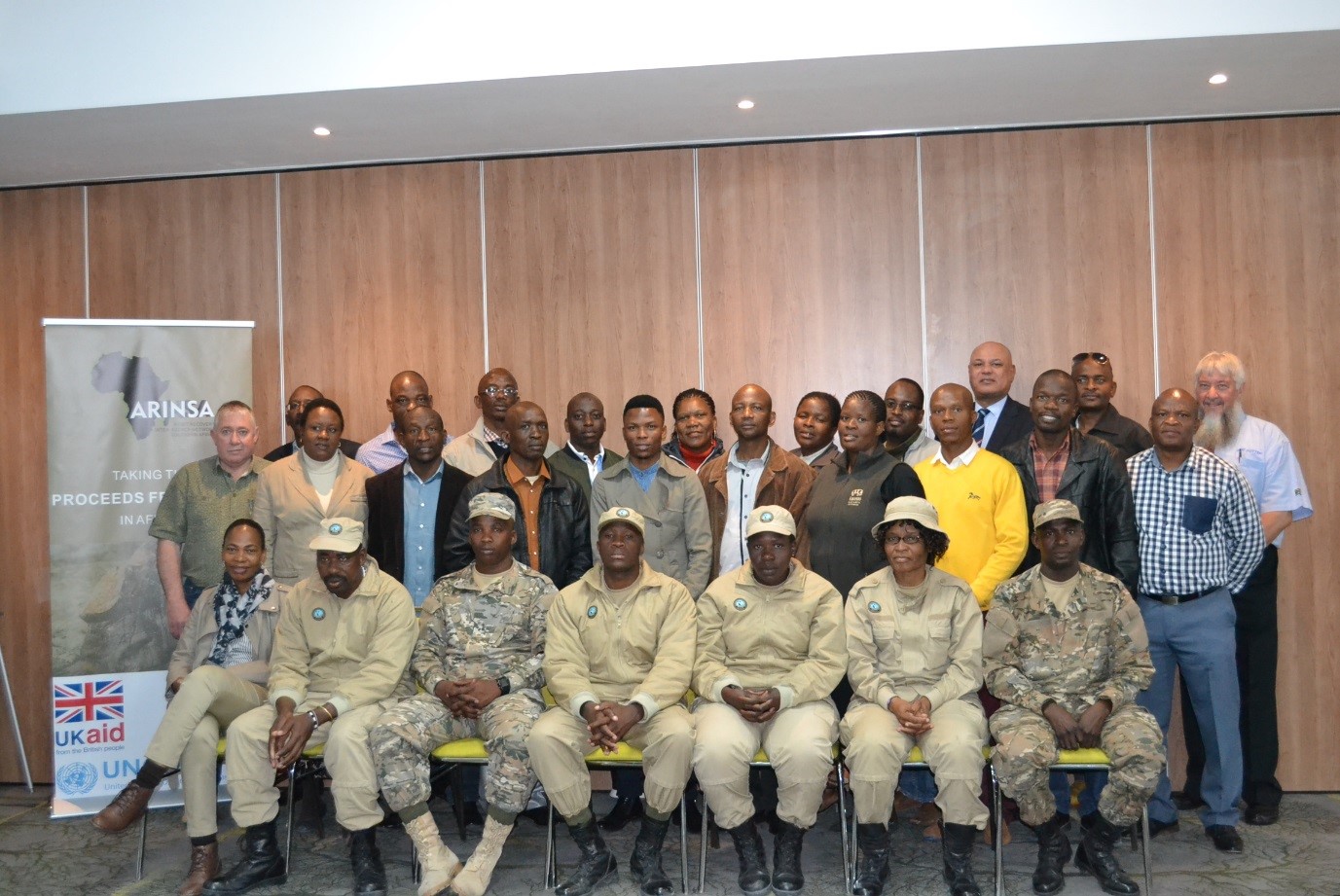
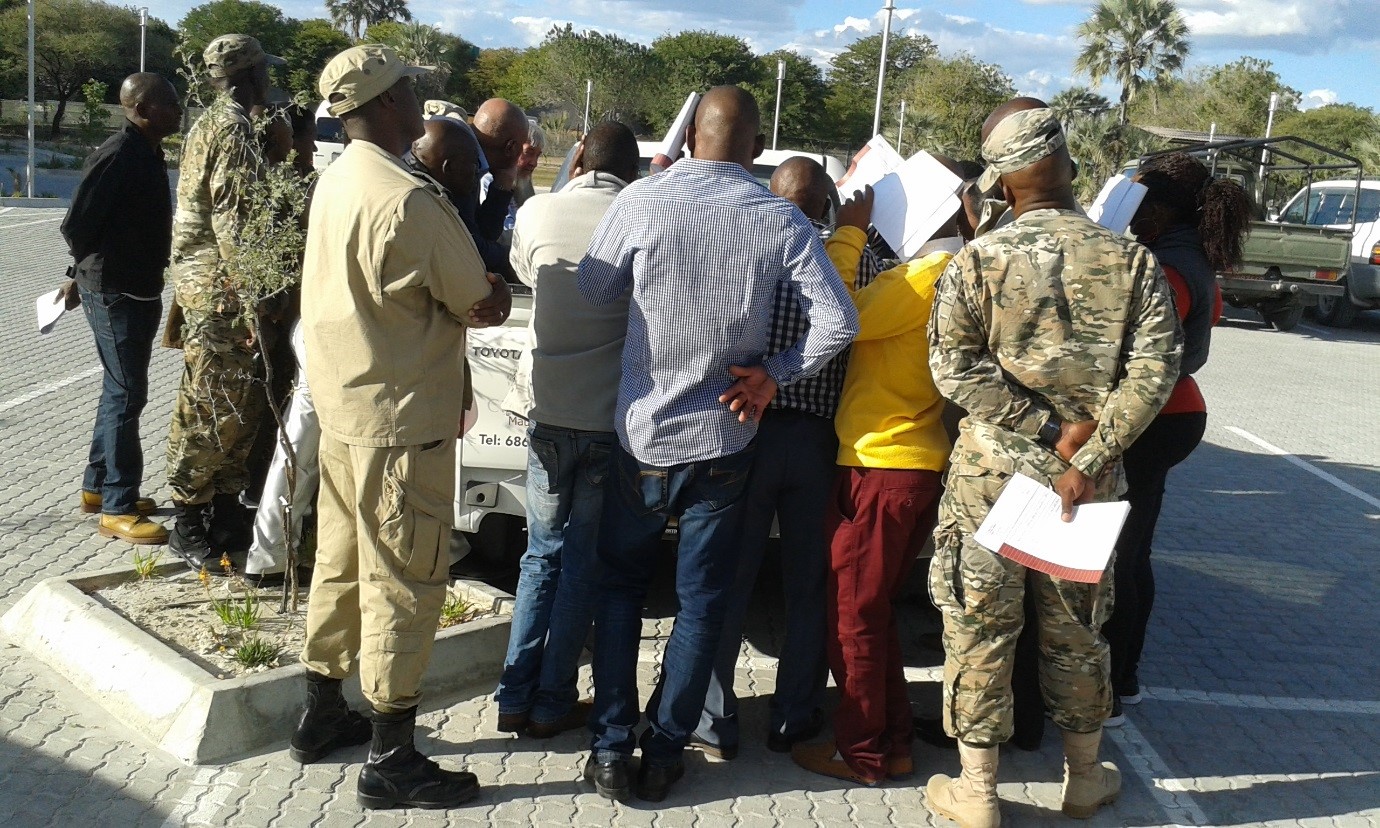
The Asset Recovery Inter-Agency Network for Southern Africa (ARINSA) recognising the heart of this problem is the profit has delivered specialised training for 40 rangers in Kasane and Maun in Botswana over the course four days. The rangers came from as far afield as the remote districts of Chobe National Park and the Central Kalahari National Park

The training did not focus on poaching offences and catching poachers, but following the money trail to lead to the confiscation of the proceeds of crime. The rangers have been identified as the key personnel as they are the first responders in wildlife crime. The evidence that is collected by them can help to identify the syndicates involved in wildlife crime and lead to their assets being confiscated.

The workshops introduced the rangers to Botswana’s Proceeds and Instruments of Crime Act of 2014 which allows for confiscation with or without a criminal conviction.

The workshops had practical exercises that addressed the following issues:

  • Searching for financial information
  • Preserving financial evidence
  • Tracing the proceeds of crime
  • Intelligence gathering
  • Presenting evidence in court

The workshops were the first of their kind and as pilot programmes will be developed to be delivered to the regions most critically affected by wildlife crime.

Hopefully, by following the money trail an applying the lessons learned this will leave the criminals with nowhere to hide.

371 words

Six KZN rhino killed in one night

by Kudzai Chinoda -

Six KZN rhino killed in one night

South Africa | 5 July 2017, 09:28am

ZAINUL DAWOOD

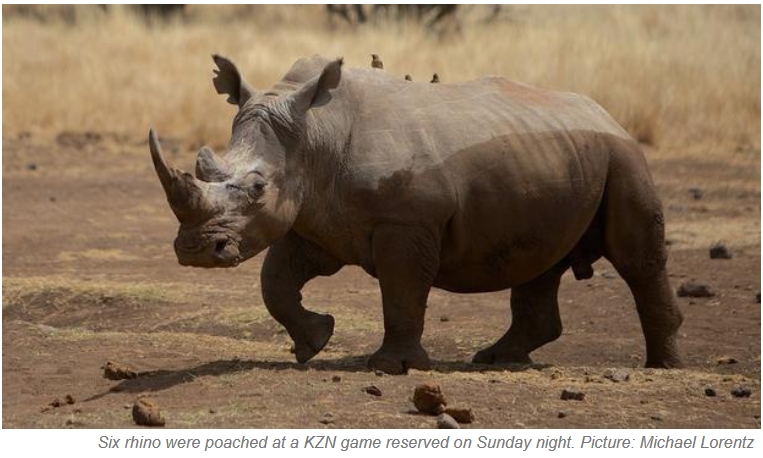
DURBAN - Poachers killed six rhinos in a single night at one of KwaZulu-Natal's biggest game reserves.

Rangers found the carcasses of six dehorned white rhino at the Hluhluwe-Imfolozi reserve on Monday morning.

"To lose six rhinos in one night is devastating," said KZN Ezemvelo Wildlife spokesman Musa Mntambo.

Mntambo said field rangers had heard gunshots late on Sunday night. Rangers and anti-poaching unit investigators found the dead rhino's in the Mbhuzane area. The gender and age of the rhinos have not been established yet.  

"We are currently under severe attack from poachers. To lose such a high number in one night is a concern. In 2016, 69 rhinos were killed in the province compared to 139 in 2017," a concerned Mntambo said.

Rangers had arrested 44 poachers last year and 70 in 2017. 

The incident follows a week after the  Department of Environmental Affairs stated that the planned sale of rhino horn by private rhino owners is for domestic trade only subject to the issuance of the relevant permits in terms of the National Environmental Management Biodiversity Act. 

"The commercial international trade in rhino horn is and remains prohibited in terms of the international protocols that South Africa is party to. The Constitutional Court judgment in April 2017 confirming the setting aside the 2009 moratorium on the domestic trade in rhino horn retrospectively does not mean that persons are allowed to trade (including selling, donating, or in any way acquiring or disposing of rhino horn) without a permit issued by the relevant provincial conservation department," said DEA spokesman Albi Modise

The DEA is still in the process of inspecting privately owned rhino horn stockpiles.

Daily News

http://www.iol.co.za/dailynews/news/south-africa/six-kzn-rhino-killed-in-one-night-10137539

301 words

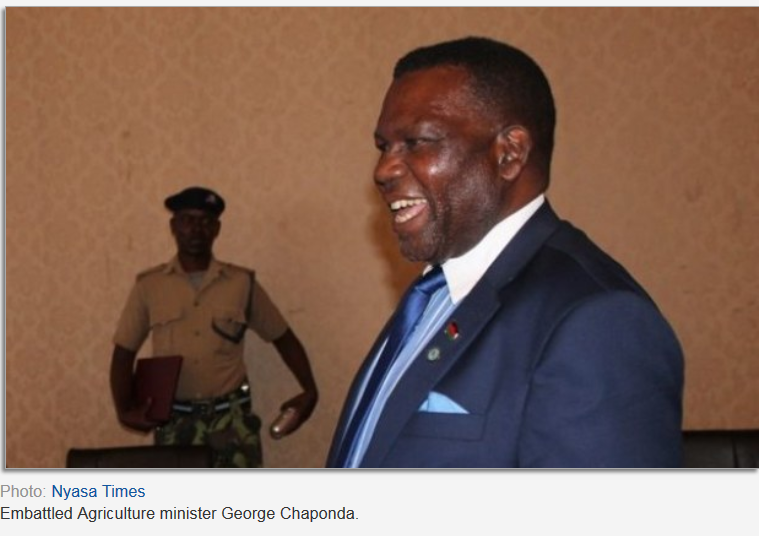
Malawi: Chaponda Arrest Looming As ACB Concludes Corruption Investigations Into 'Maizegate'

by Kudzai Chinoda -

Malawi: Chaponda Arrest Looming As ACB Concludes Corruption Investigations Into 'Maizegate'

By Green Muheya


Graft busting body, the Anti-Corruption Bureau (ACB) has concluded its investigations into corruption element in Malawi's maize imports from Zambia involving George Thapatula Chaponda--the erstwhile Minister of Agriculture, Irrigation and Water Development and Leader of the House -- and an arrest is looming.

Two state sponsored public inquiries recommended that Chaponda, who is also the vice president of the ruling Democratic Progressive Party (DPP), should be investigated.

Chaponda could be arrested after Parliament adjourns this week.

Reyneck Matemba, the deputy director of the ACB said the bureau concluded its investigations three weeks ago on forensic investigation of suitcases stashed with cash - US$58,000 and MK124 million seized at Chaponda's house during the raid in February this year.

ACB raided Chaponda's residence following a recommendation by the commission of inquiry into Malawi's maize imports from Zambia that he should be investigated.

Matemba said ACB is coming up with good charges for Chaponda.

"We need to come up with a very good case and good analysis ..." he said.

"If we are to charge Dr Chaponda with existing currency exchange laws on the money we found in his house, then he could get away with very lenient sentence and the people would blame us for this. People should be patient. We cannot start to prosecute him in piece meal. We cannot start isolating cases," he said.

Asked recently on Capital Radio's Straight Talk program when ACB will summon Chaponda for questioning.

"At the bureau we do not just summon an accused person for questioning when we do not have basis. Being found with money in your house is not a criminal offence on its own," said Matemba who is also ACB prosecutor.

Matemba said they wanted to finalise the investigations and invite Chaponda for "questioning."

He said the bureau has been working closely with Reserve Bank of Malawi on the cash which was seized from Chaponda's residence.

"We will be inviting him to be questioning. We are not shielding Chaponda," he said, adding "one aspect of investigation can lead to another."

But law experts say Chaponda has been afforded enough time and space to build his story, saying investigations could have gone ahead having interviewed him under caution which is not a presumption of guilt.

Chaponda justified why he is cash-rich after they confiscated at least K166 million stashed in suitcases at his house, saying he has worked for the United Nations (UN) for over 20 years and has his own investment.

He also submitted his assets declaration form to ACB which indicates he hold many bank accounts in foreign countries where he worked for UN.

A lists of assets Chaponda declared as of February 1, 2017 seen by Nyasa Times shows that he has 20 real estate properties in Lilongwe, Blantyre, France, Luchenza, Mangochi, Thyolo and Chiradzulu.

According to Chaponda declaration, the source of funds for the property, valued at K853 million, included bank loans and his earnings from the UN, United Kingdom, South Africa, France and his children abroad and Chaponda investments.

In a political rally in his Mulanje South West constituency at Chonde in Mulanje recently, Chaponda said he was ready and prepared to be arrested.

"I have been waiting to be arrested because people have been saying so," said Chaponda, a lawyer by profession.

He denies any wrong-doing.

"The law says you are innocent until proved guilty, so I am not afraid, let them prove me guilty," said Chaponda.

Legal commentator based at South Africa's University of Cape Town, Professor Danwood Chirwa argued that Chaponda has "committed or is alleged to have committed a litany of legal infringements including flouting procurement law, gross negligence in the discharge of his public duties, perjury, arson, corruption and money laundering."

University of Malawi political scientist Boniface Dulani is in record saying that the decision to fire Chaponda from Cabinet was forced on President Peter Mutharika who would have maintained the minister if he had his way.

Dulani said the ‘Maizegate’ just like Cashgate on Joyce Banda will forever be associated with the Mutharika's regime.

685 words

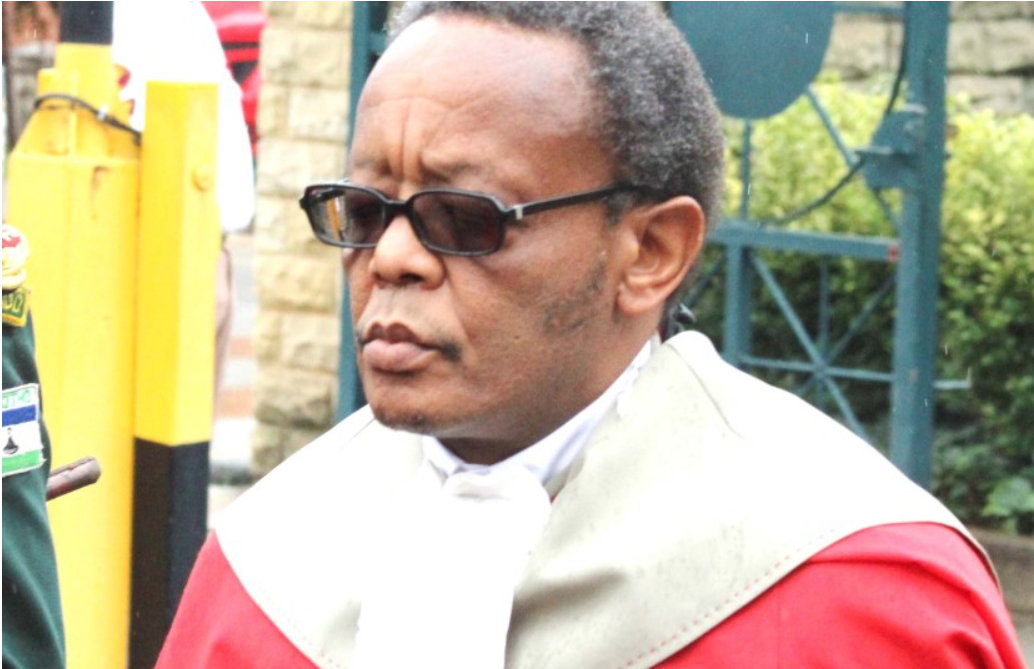
Judicial Retreat Instils Pride - Lesotho

by Kudzai Chinoda -

Judicial Retreat Instils Pride


By Relebohile Koloti

Maseru – A judicial retreat is a once-in-a-decade moment that instils pride in the Judiciary.

In his welcoming remarks at the Judicial Retreat to exchange ideas on Money Laundering and Proceeds Crime 2008, its Amendment of 2016 and Penal Code Acts of 2010, Justice Semapo Peete said the Lesotho Judiciary’s has a long-distinguished history of excellence, industry, impartiality, fearlessness, research, and unrivalled integrity.

He said this is the first time after a long period that a judicial retreat is held in Lesotho as the last one was held in 2006 in Mohale’s Hoek, saying the importance and rarity of the gathering can also be gleaned from the calibre of its participants.

He thanked the United Nations Office on Drugs and Crime and the Financial Intelligence Unit for technical expertise and funds to make the gathering a success, and called on the Executive and the Legislative branches of government to allocate funds to the Judiciary for future retreats.

Justice Peete however acknowledged the scarce financial resources and funds for government initiatives across the broad spectrum, which might lead to frugality in expending public funds.


189 words

Interpol arrests two Limpopo brothers for fraud, money laundering

by Kudzai Chinoda -

Interpol arrests two Limpopo brothers for fraud, money laundering

2017-06-22 22:46

Simon Bloch, News24 Correspondent

Polokwane - The Interpol task team has arrested professional hunting brothers, Dawie Groenewald, and Janneman, in Polokwane, Limpopo.

Their arrest early on Thursday morning comes exactly a week after the state’s long-running case against Dawie Groenewald, his wife Sariette and nine others was postponed again in the Pretoria High Court. 

It is understood Janneman was arrested at his home, while Dawie was said to have handed himself to the authorities.

While details around the Thursday's raid remain sketchy, Hawks spokesperson Brigadier Hangwani Mulaudzi confirmed the arrest of the brothers at their homes, in order to facilitate the US government’s request for the brothers’ extradition to face charges there.

"Interpol executed an international warrant of arrest issued from the USA where Mr Groenewald and his brother are wanted for various charges by the US Department of Justice. They were assisted by the Limpopo Endangered Species Unit, and the Tactical Response Unit," Mulaudzi said.

The US indictment, issued in 2014, charges Dawie and Janneman Groenewald, and their company Valinor Trading CC (d/b/a Out of Africa Adventurous Safaris) with conspiracy, Lacey Act violations, mail fraud, money laundering and structuring bank deposits to avoid reporting requirements.  

The Lacey Act is the US' oldest criminal statute addressing illegal poaching and wildlife trafficking, making it a crime to sell animal hunts conducted in violation of state, federal, tribal and foreign law.

Nine American hunters paid up to $15 000 (R650 000) per animal for a total of 11 hunts sold at hunting conventions and gun shows in the United States between 2005 and 2010.

The hunters were tricked by the Groenewalds into believing they were shooting legally at "problem" rhino. The Groenewalds obtained no hunting permits from the South African or local government, and the hunters never received the horn "trophies", the indictment said.

Extradition 

The hunts took place at Prachtig, the ranch in Musina, Limpopo, which is co-owned by the Groenewalds and American investors, according to the indictment.

Both Groenewald brothers are South African nationals. Janneman lived and operated out of Alabama's Autauga County, where he maintained company bank accounts.

Asked why it had taken so long for Interpol to act and serve the Groenewalds with the US Department of Justice’s warrant of arrest for extradition, issued in 2014, Mulaudzi told News24:

"There are certain treaties and agreements that need to be followed. There are also procedures and due processes that need to be adhered to, and eventually, when both countries reach an understanding, those warrants can be executed. Crime has no boundaries.

"The warrant comes from Interpol, not from the South African authorities, and when we received it, we executed. They were arrested this morning, and are currently in court in Polokwane where they are expected to appear,” Mulaudzi said.

"Interpol is going to oppose any immediate bail application, and this will necessitate them to do a proper profiling of Janneman Groenewald, Mr Groenewald’s younger brother. This is necessary to make sure the case against them is tight when they apply for bail in perhaps seven days so that the court has enough evidence about him and his dealings," Mulaudzi said. 

Asked whether the authorities believed the extradition application would succeed, Mulaudzi added:
"They are extremely confident. The criminal court case here will still continue, but it will depend on the Department of Justice, Interpol and the NPA to establish which cases they will prioritise".

Dawie, his wife Sariette, and nine others, including two vets and professional hunters, were arrested on World Rhino day, September 2010, and face a massive total of 1872 charges, but have managed to stave off prosecution since their arrest.

Authorities excavated the carcases of 26 rhinos they allege were illegally hunted and dehorned without permits.

That case was postponed until January 29th, 2018. Asked to comment on the arrest of Dawie, Sariette told News24:

"I don't know anything about it. Listen, I have been divorced since two years ago. Leave me alone".


670 words

Madagascar and Mozambique welcomed into ARINSA as members report USD 23 million in seized assets!

by Kudzai Chinoda -

Madagascar and Mozambique welcomed into ARINSA as members report USD 23 million in seized assets!


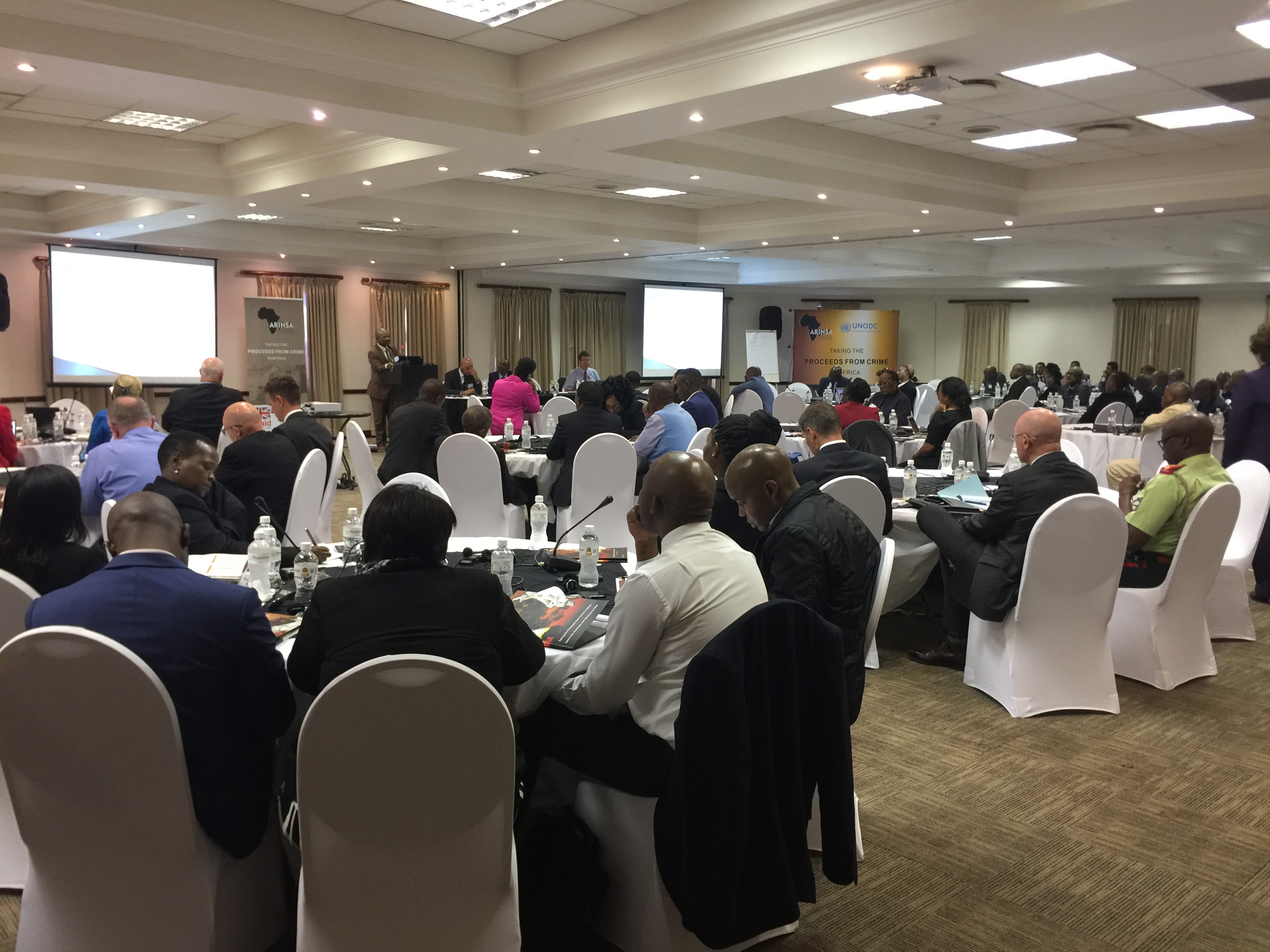
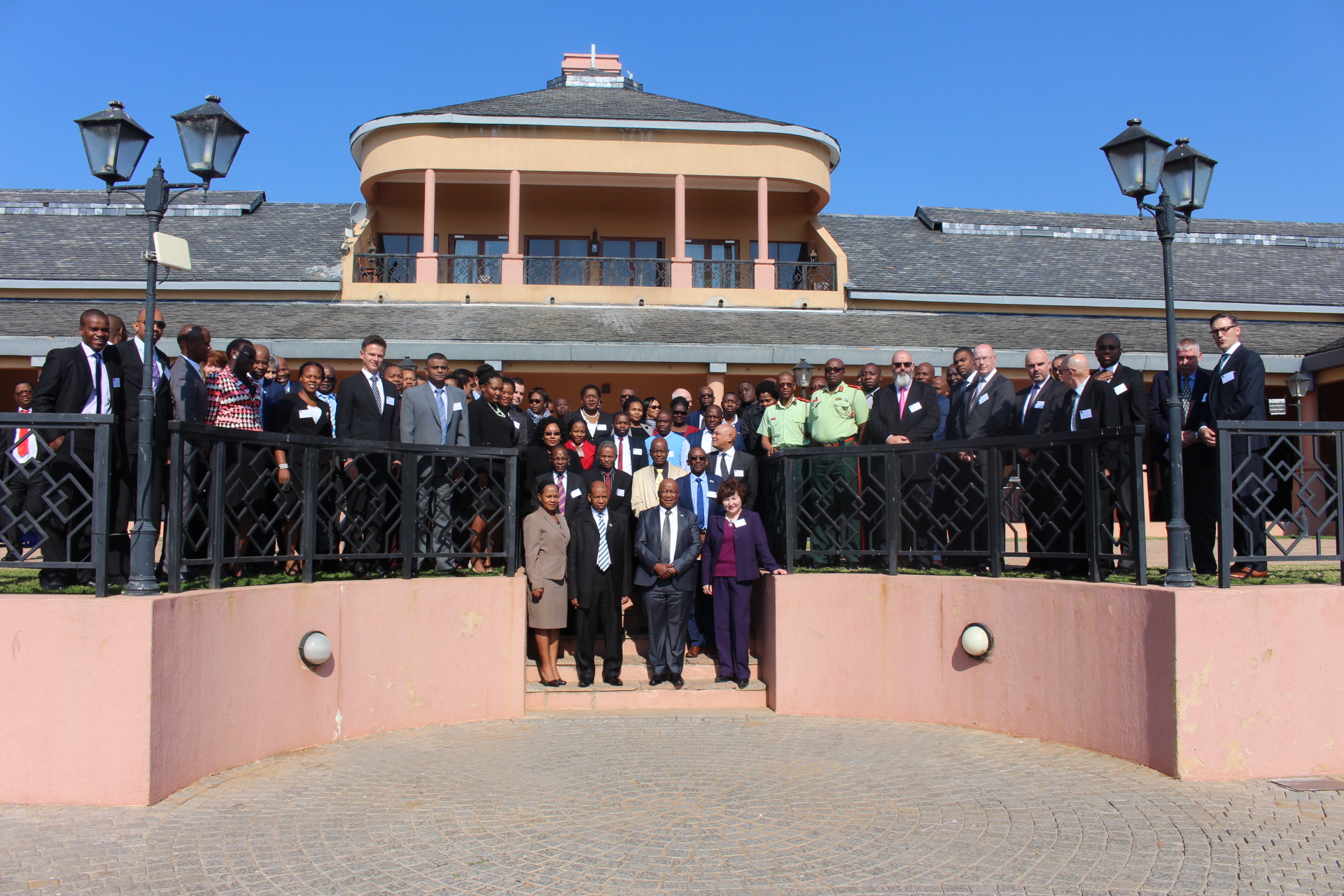
ARINSA members were welcomed to the Annual General Meeting by their president Mpho Letsoalo in Gaborone, Botswana, 06 - 7 June 2017.


The annual event brought together 107 (including 45 females) asset forfeiture practitioners from the police, financial intelligence units and prosecuting services agencies from Angola, Botswana, Democratic Republic of Congo (DRC), Kenya, Lesotho, Malawi, Mauritius, Madagascar, Mozambique, Namibia, Seychelles, South Africa, Swaziland, Tanzania, Uganda, Zambia and Zimbabwe to discuss issues of mutual interest and concerns in relation to asset recovery, worldwide.


The Honourable Minister of Presidential Affairs, Governance and Public Administration, Mr Eric Molale gave the keynote address and remarked as follows:


 “The expansion and administrative consolidation of ARINSA is a reflection of its member’s commitment to increase their effectiveness in depriving criminals of their illegal proceeds from criminal activities”.  


The theme of the 7th ARINSA AGM was the development of national strategies for the management of seized assets. Mr Molale again remarked:


The value chain of implementing an effective asset forfeiture regime includes the establishment of an asset management directorate”.  He further stated that “Asset management remains critical and an important function of achieving the goal of depriving criminals of their ill-gotten gains”.


Presentations were made by the member countries on their asset recovery achievements during the 2016 financial year. Significant achievements that stood out including that:


  • US$23m worth of assets were forfeited,
  • 419 cases of money laundering currently undergoing investigation,
  • 178 vehicles worth over US$2m were seized, and
  • US$5,6m worth of gold and other assets such as cattle were seized.


Countries attributed the successes to the continuing assistance from UNODC including Judicial training, regional and national workshops on money laundering and terrorist financing and the mentor placement programme which began in 2015. Countries also benefited from the prosecutor placement programme which is hosted by the National Prosecuting Authority of South Africa.


The ARINSA Secretariat presented UNODC’s e-learning opportunities which can be accessed through the ARINSA website (http://arinsa.org), which is mainly used for sharing best practices, case law and cases of significant interest.


Furthermore, the meeting was informed by the steering committee of the admission of Mozambique and Madagascar into the ARINSA network.  

The AGM agreed that country assessments should be carried out to determine the status of the asset management legal framework. Further to that more judicial retreats are to be carried out in the region and countries must submit requests for technical assistance to enhance a multi-disciplinary approach in dealing with asset recovery cases.


For more information on the activities and asset recovery success stories, please see the ARINSA 2016 Annual Report.


Other resources related to this AGM were covered in the media and are available on the links below:


Key note address by the Minister:

https://www.facebook.com/Botswana.Government/posts/1346481915434463:0


News:

http://www.dailynews.gov.bw/news-details.php?nid=36481


News:

http://apanews.net/en/news/botswana-hosts-regional-asset-forfeiture-seminar

496 words

Act saves state millions

by Kudzai Chinoda -

Act saves state millions

Money exceeding P20 million has either been restrained or awarded to the state since the Proceeds and Instruments of Crime Act (PICA) came into operation in January 2015, Minister for Presidential Affairs, Governance and Public Administration, Mr Eric Molale said Tuesday.

PICA was passed by Parliament in August 2014 to deprive criminals of their illicitly gained profits by introducing new provisions on non-conviction based asset recovery brought through civil forfeiture, civil penalty and administrative forfeiture applications which were absent in the previous legislation.

Mr Molale told a 2017 annual general meeting of the Asset Recovery Inter-Network for Southern Africa (ARINSA)  in Phakalane that proceeds made through application of the PICA legislation would in turn be used to further combat various forms of organised crime through capacity building for law enforcement agencies.

He also said proceeds would assist in compensating crime victims and support other projects developed to deprive criminals of crime proceeds.

“Proceeds will also render assistance to prescribed persons, prescribed investigators, the office of the receiver, the Financial Intelligence Agency, the Directorate of Public Prosecutions (DPP) and Law Enforcement Agencies,” he said.

Thus, he urged law enforcement agencies to provide their investigators with specialised training around complex criminal offences.

He indicated that specialised training around complex criminal offences incuding money laundering, racketeering, cyber-crime, terrorist financing, human and drug trafficking remained critical, hence the need for well-coordinated investigations by all stakeholders.

He added that prosecutors also required specialised training and mentoring in the new provisions of PICA which he said were more civil in nature and different from the day to day prosecution of common criminal offences.

Mr Molale thus commended the DPP for training more than 50 police officers on PICA as well as Asset Tracing and Freezing.

“I am informed that the regulations to PICA are still being drafted and currently with the Attorney General wherein there will also be provision for establishment of Asset Tracing Units, within law enforcement agencies, which complement the Asset Forfeiture Unit at the Directorate of Public Prosecutions,” he said.

He also commended ARINSA member states for increasing their effectiveness in depriving criminals of illegal proceeds from criminal activities.

Meanwhile, PICA was established with 10 member states in 2009 through the United Nations Office on Drugs and Crime (UNODC) Global Programme Against Money Laundering initiative as a working group of asset recovery practitioners, including investigators and practitioners.

Membership has now increased to 12 countries.

Further, Mr Molale urged ARINSA members to develop regulatory framework for asset management. On the other hand, DPP director, Advocate Abram Keetshabe said response to sophisticated crime required all crime fighting agencies in the region to work together. ARINSA, he said therefore played an important role of facilitating networking between agencies. ENDS

Source : BOPA

Author : Jeremiah Sejabosigo

Location : GABORONE

Event : ARINSA AGM

Date : Jun 08 Thu,2017

472 words